রবীন্দ্রনাথ ঠাকুরের Gora-কে কেন্দ্র করে জাতীয়তাবাদ, ধর্মীয় পরিচয়, আত্ম-সংকট এবং বিশ্বমানবতার দার্শনিক উত্তরণকে চিত্রভিত্তিক একাডেমিক কাঠামোয় উপস্থাপন করা হয়েছে।
Headline
গোরা: জাতীয় পরিচয়ের সন্ধান, ধর্মীয় দ্বন্দ্ব ও মানবতার উন্মেষ-Prof. Dr. Milton Biswas
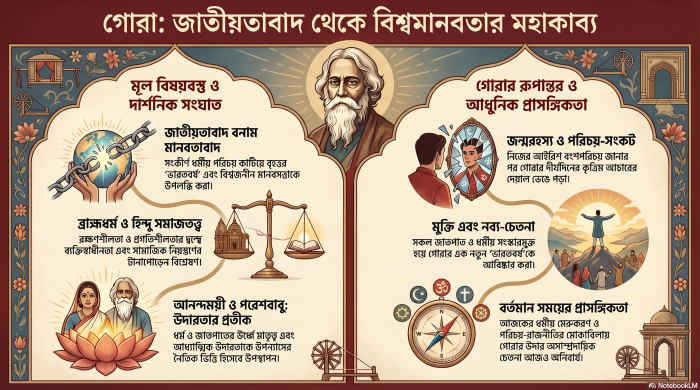
রবীন্দ্রনাথ ঠাকুরের গোরা জাতীয়তাবাদ, ধর্মীয় পরিচয়, সামাজিক দ্বন্দ্ব এবং বিশ্বমানবতাবাদের এক অনন্য সাহিত্যিক অনুসন্ধান। এই গবেষণাধর্মী আলোচনায় গোরার আত্মপরিচয়ের সংকট, হিন্দু-ব্রাহ্ম মতাদর্শিক সংঘাত এবং আনন্দময়ীর সার্বজনীন মানবতাবোধ বিশ্লেষণ করা হয়েছে।
Gora: A Search for National Identity
Gora and the Crisis of Identity: Nationalism, Religion and Humanism in Tagore
A research-based literary study on nationalism, Hindu-Brahmo conflict, and Anandamoyi’s universal humanism in Rabindranath Tagore’s Gora.
Feature Summary: This essay examines how Tagore transforms the question of nation into a deeper moral inquiry about identity, humanity, and belonging. Through Gora’s inner journey, the novel moves from ideological rigidity toward inclusive humanism.
Introduction
Rabindranath Tagore’s Gora stands as one of the most important novels in Bengali literature for its powerful engagement with nationalism, religious identity, and the moral crisis of colonial society. More than a political novel, Gora is a philosophical exploration of selfhood. It examines how an individual’s social, religious, and national convictions can be shaken when confronted with the truth of origin and the ethical demands of humanity.
At the center of the narrative is Gora, a young man deeply committed to orthodox Hindu identity and a militant vision of Indian nationalism. Yet Tagore gradually leads him toward a profound realization: no nation can be built upon exclusion alone, and no identity is complete without a larger human consciousness.
Key Areas of Discussion
- Gora’s nationalistic worldview and ideological certainty
- The transformation caused by the revelation of his true identity
- The conflict between orthodox Hinduism and the Brahmo Samaj
- Anandamoyi as a symbol of universal motherhood and human compassion
- Tagore’s movement from nationalism to humanism
Gora’s Shift in National Consciousness
Gora initially believes that India’s strength lies in an uncompromising Hindu identity. For him, religion, culture, and nation are inseparable. His patriotism is intense, disciplined, and often exclusionary. He sees the nation not as a plural reality but as a sacred civilizational body rooted in orthodox tradition.
The crisis emerges when he discovers that he is not Hindu by birth at all. This revelation dismantles the very foundation of his ideological self. The beliefs that once gave him certainty suddenly lose their inherited legitimacy. But Tagore does not leave him in despair. Instead, the collapse of false certainty opens the path toward a deeper truth. Gora comes to understand that love for the country cannot rest solely on birth, caste, or sectarian identity. In that transformation lies the novel’s most powerful philosophical movement.
Hinduism and the Brahmo Samaj
One of the central tensions in Gora is the ideological conflict between orthodox Hindu society and the reformist Brahmo Samaj. Tagore presents this conflict not merely as a doctrinal disagreement, but as a larger struggle over the future of Indian society. Orthodox Hinduism represents inherited authority, ritual structure, and continuity with the past. The Brahmo Samaj, by contrast, stands for reform, rationality, conscience, and ethical spirituality.
Gora’s resistance to the Brahmo world reflects his anxiety that reform may weaken cultural identity. Yet Tagore complicates this opposition by giving moral depth to both sides. The novel does not endorse a simplistic victory of one camp over the other. Rather, it reveals the limitations of rigid orthodoxy and the incompleteness of reform when detached from the lived emotional history of the people.
Anandamoyi and Universal Motherhood
Anandamoyi is one of the most luminous figures in the novel. She transcends sectarian division and embodies a form of motherhood grounded in unconditional acceptance. She does not define people through caste, creed, or doctrine. Her vision is deeply ethical, intuitive, and inclusive. In many ways, she represents Tagore’s highest human ideal.
Through Anandamoyi, the novel offers a critique of all narrow identities. She becomes a moral counterpoint to ideological rigidity. Her presence softens conflict and widens the horizon of belonging. She is not simply a mother figure within the domestic sphere; she is the symbolic bearer of a larger civilization of compassion. In her, Tagore imagines a humanity beyond boundaries.
Why This Study Matters Today
Gora remains strikingly relevant in contemporary discussions of nationalism, religious identity, pluralism, and social harmony. In a world where political identities are often hardened into exclusionary forms, Tagore’s novel reminds us that the deepest foundation of community is not fear, but recognition of shared humanity.
This study is valuable for students, researchers, teachers, and readers interested in Bengali literature, comparative literature, postcolonial thought, identity studies, and Tagore scholarship.
Read the PDF
You may read the full research PDF below.
Conclusion
In Gora, Tagore turns the crisis of identity into a profound ethical awakening. The novel begins with nationalism rooted in exclusion, but ends in a recognition of humanity beyond inherited boundaries. Gora’s transformation is therefore not a defeat of patriotism, but its moral expansion. Through Anandamoyi’s compassion and the conflicts of colonial society, Tagore offers a vision of India that is richer than dogma and greater than sectarian pride.